Building performance
Ventilation monitoring — measuring fresh air, not assuming it
A ventilation system that worked at commissioning does not always keep working. Continuous monitoring is how operators turn an assumption about fresh air into evidence — and into a signal the system can act on.
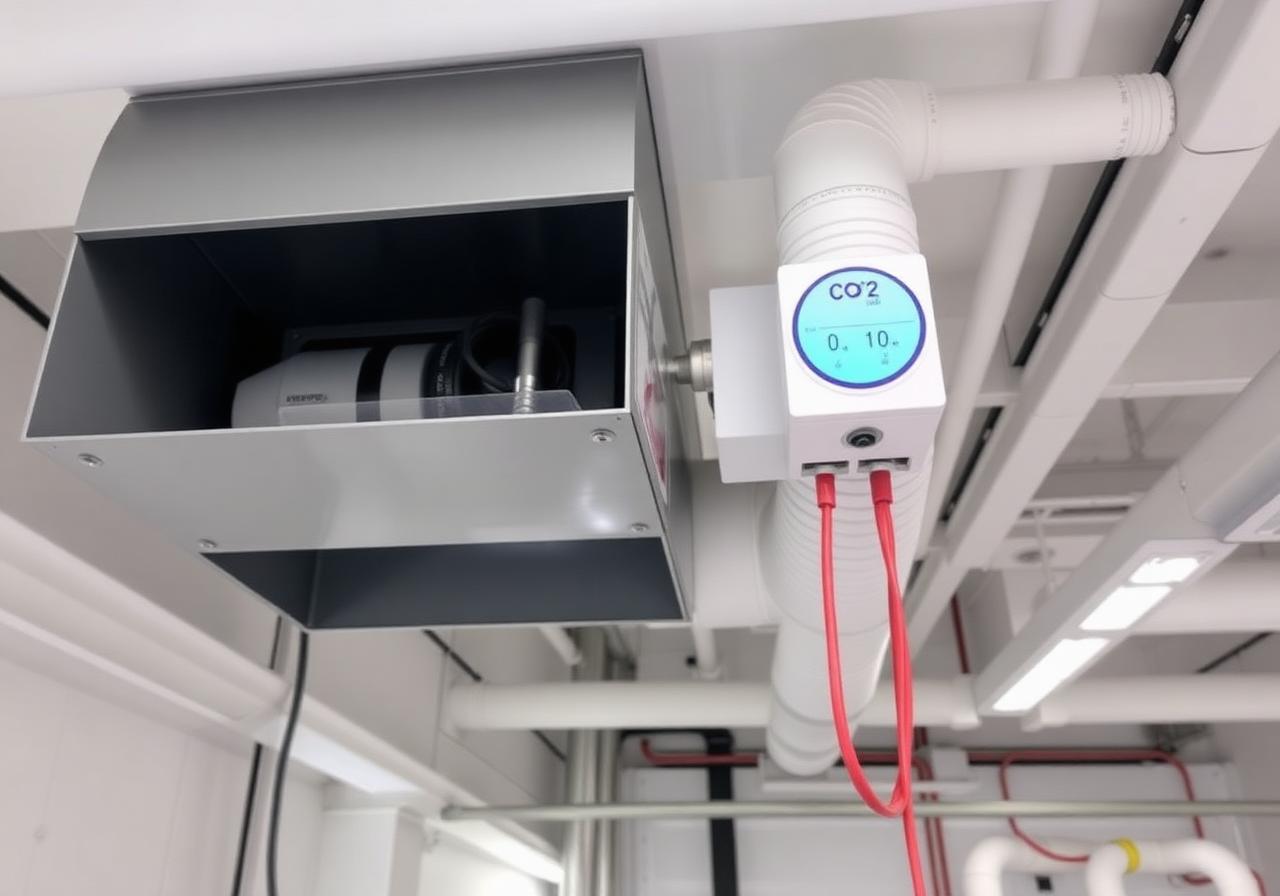
Indicators
What ventilation monitoring measures
CO2 concentration
Above ambient, indoor CO2 reflects occupant respiration relative to outdoor air supply. A practical, scalable indicator of how stale the air has become.
Temperature and humidity
Supply and extract conditions reveal whether the system is conditioning air to setpoint and whether moisture loads are being removed.
Occupancy patterns
PIR or counting sensors correlate fresh-air demand with actual use, exposing systems running at schedule rather than need.
Differential pressure
Across filters and zones, pressure trends flag loading, leakage and balance issues before they become complaints.
Demand-controlled ventilation
From schedule to signal
Time-clock ventilation runs whether anyone is there or not. Demand-controlled ventilation uses CO2, occupancy and sometimes humidity to modulate supply rates in real time, increasing fresh air when spaces fill and reducing it when they empty.
The energy case is well-established; the indoor air case is just as strong. Spaces that previously ran under-ventilated during peak occupancy receive the air they need, while empty spaces stop conditioning air for nobody.
Done well, it requires honest sensors, sensible control sequences and a BMS integration that does not over-react to short-lived spikes. Done badly, it whiplashes occupants between stuffy and draughty.
Applications
Where the data shapes decisions
| Setting | Primary use | Typical action |
|---|---|---|
| Classrooms | CO2 trend through teaching periods | Open windows; adjust mechanical supply |
| Open-plan offices | Demand-controlled supply by zone | BMS modulation against CO2/occupancy |
| Meeting rooms | Peak CO2 during bookings | Booster supply, occupancy limits |
| Healthcare estates | Ventilation rates per HTM 03-01 | Validation, alarms, audit trail |
| Retrofit projects | Pre/post performance comparison | Specification and acceptance evidence |
Limits
Where CO2-only stops being enough
Non-occupant pollutants
Solvents, cleaning products and printers emit irrespective of CO2. A low reading does not mean clean air.
Outdoor ingress
NO2 and PM from outside can rise while CO2 stays low. Outdoor air is the supply, not the contaminant in this case.
Short-cycling spikes
Aggressive control on raw CO2 creates oscillation. Smoothing, deadbands and minimum runtimes matter.
Sensor placement
A CO2 sensor on a return grille tells a different story than one in the breathing zone. Both have a role; conflating them misleads.
Suitable for
Buildings that benefit most
Schools and universities
Variable occupancy, statutory ventilation expectations and high attainment stakes.
Offices and workplaces
Hybrid attendance patterns make scheduled ventilation expensive and inaccurate.
Healthcare and labs
Performance evidence for HTM 03-01 and operational assurance for sensitive spaces.
FAQ
Ventilation monitoring questions
Discuss an Air Quality Monitoring Project
Ventilation performance monitoring, demand-controlled strategies and BMS integration for UK buildings.
Request ventilation monitoring adviceFurther reading