Pollutants and parameters

How CO₂ Monitoring Works

Carbon dioxide is the single most useful indoor air parameter — not because it is harmful at typical indoor levels, but because it is the cleanest available proxy for whether a space is being adequately ventilated for its occupants.

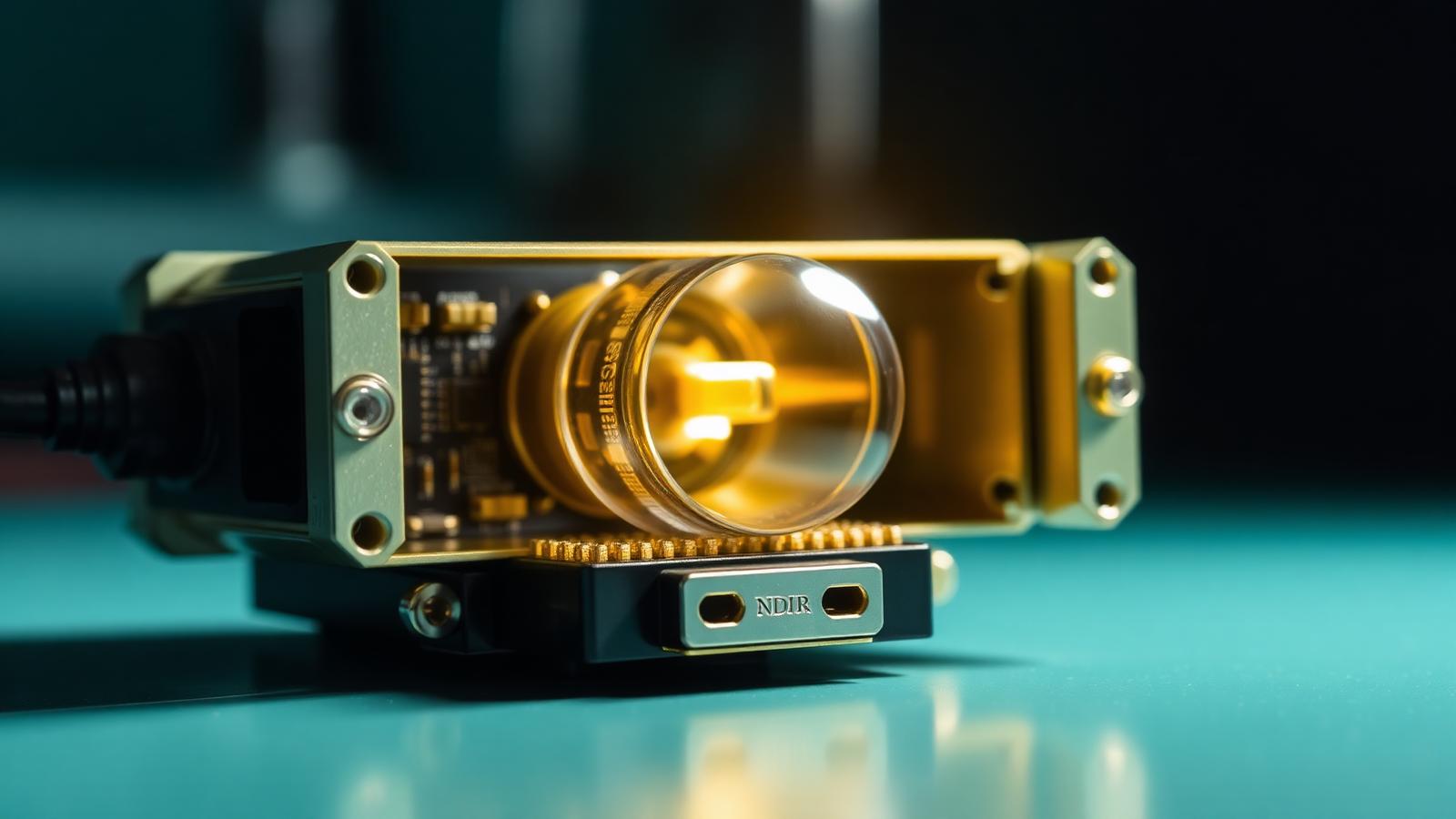
Macro photograph of an NDIR carbon dioxide sensor module

Outdoor baseline

~420 ppm

Ventilation target

<1,000 ppm

Sensor type

NDIR

Response time

30–120 s

01

Why CO₂ is monitored

Humans exhale carbon dioxide at roughly 0.005 m³/min at sedentary metabolic rate. In an unventilated room the concentration rises predictably with occupancy and density; in a ventilated room it stabilises at a level that reflects the balance between the exhaled flux and the fresh air supply rate. That makes indoor CO₂ a near-perfect tracer for ventilation effectiveness.

CO₂ itself becomes a direct cognitive issue at sustained concentrations above ~1,500 ppm, with measurable decision-making impairment from 2,500 ppm in controlled studies. More importantly, elevated CO₂ correlates with elevated bioeffluents, infectious aerosol concentration and occupant complaint rates. See CO₂ monitoring for the deployment overview.

02

How NDIR sensors work

Almost every commercial CO₂ monitor uses non-dispersive infrared (NDIR) sensing. The principle is straightforward: CO₂ absorbs infrared light strongly at 4.26 µm. An NDIR sensor consists of an infrared source, an optical chamber that air diffuses into, and a detector with a narrow-band filter centred on 4.26 µm. The reduction in transmitted infrared light is proportional to the CO₂ concentration in the chamber, following the Beer-Lambert law.

Practical NDIR sensors fall into two architectures. Single-wavelength sensors are low-cost and use auto-baseline calibration (ABC) — the sensor assumes the lowest concentration it sees over a 7–14 day window is outdoor air (~420 ppm) and rebases accordingly. Dual-wavelength sensors add a reference detector at a non-absorbing wavelength, eliminating drift caused by source ageing, optical contamination or window soiling. Dual-wavelength sensors are the standard for serious monitoring.

NDIR is preferred because it is selective for CO₂, has a long working life (typically 10+ years), is unaffected by humidity in normal indoor ranges and recovers fully from over-range events.

03

Occupancy, ventilation and the CO₂ curve

A CO₂ trace through a working day is a fingerprint of how a space is used. A typical occupied meeting room shows four phases: a pre-occupancy baseline near outdoor level, a sharp rise on occupancy, a plateau as the ventilation rate matches the metabolic source, and an exponential decay after occupants leave.

The plateau height is the diagnostic value. CIBSE TM40 and the ventilation monitoring guidance translate plateau CO₂ into approximate fresh air rates per person, using the relationship Q ≈ G / (C - C_outdoor). A classroom plateau at 1,800 ppm with 30 occupants implies less than 5 l/s/person — well below the Building Bulletin 101 design target.

The decay phase reveals the air change rate. A first-order exponential fit to the decay curve gives a direct ACH measurement without tracer gas equipment, provided the space is unoccupied and the system is in its normal operating state.

04

Sensor placement

CO₂ readings are highly dependent on where the sensor is. Useful placement principles:

Breathing zone height. Mount at 1.1–1.7 m above finished floor level, where the data is representative of occupant exposure.

Away from sources. Avoid placement above or behind seated occupants; their exhalation plume can bias readings by 200–400 ppm.

Away from supply diffusers. A monitor 0.5 m from a ceiling supply will read close to outdoor air regardless of room average.

One per occupied zone. Open-plan offices need multiple monitors when mixing is poor; a single mid-room sensor will under-report perimeter zones.

For schools and densely occupied rooms, fixed wall-mounted monitors are the durable choice. For workplaces with flexible occupancy, networked desk-level sensors give better spatial coverage.

05

Schools, workplaces and commercial buildings

Schools. Department for Education guidance set 1,500 ppm as a daily peak ceiling and 1,000 ppm as a daily average target. The CO₂ monitor specification for new and refurbished classrooms is in school air quality monitoring; the same monitors satisfy the BB101 ventilation evidence requirement.

Workplaces. HSE has no direct CO₂ limit but uses it as a marker for adequate ventilation under the Workplace (Health, Safety and Welfare) Regulations. Sustained levels above 1,500 ppm trigger an investigation under most corporate IAQ policies. See workplace air quality monitoring.

Commercial buildings. BREEAM Hea 02 awards a credit for continuous CO₂ monitoring in densely occupied spaces; WELL Air feature A06 requires real-time CO₂ display. Both standards expect indicative-grade monitors with documented placement and calibration.

06

What CO₂ data does not tell you

CO₂ tracks occupant-generated pollutants and ventilation rate. It does not track:

Building-material VOCs — formaldehyde from MDF and adhesives is not occupant-driven.

Particulates — cooking, printing, outdoor infiltration and resuspension are PM sources that emit independently of occupancy.

Combustion products — gas hobs, faulty boilers and adjacent traffic generate CO and NO₂ without raising indoor CO₂.

For a complete picture, CO₂ should be paired with PM and TVOC at minimum. Single-parameter monitoring is appropriate only when the question is genuinely a ventilation question. When additional parameters matter, see indoor air quality monitoring.

07

Frequently asked questions

  • What is a healthy indoor CO₂ level?

    Outdoor background is ~420 ppm. Indoor CO₂ below 800 ppm reflects good ventilation; 800–1,000 ppm is acceptable in most occupied spaces; 1,000–1,500 ppm indicates marginal ventilation; sustained levels above 1,500 ppm are associated with measurable cognitive impairment and warrant intervention.

  • Does CO₂ correlate with other pollutants?

    Only with occupant-generated pollutants — bioeffluents and exhaled bioaerosols. CO₂ does not track building-material VOCs, particulates, ozone or combustion gases. Treating CO₂ as a proxy for 'air quality' as a whole leads to systematic blind spots.

  • How accurate are NDIR CO₂ sensors?

    Modern dual-wavelength NDIR sensors achieve ±30–50 ppm + 3 % of reading after factory calibration, with drift of roughly 1–2 % per year. Single-wavelength sensors with auto-baseline correction drift faster and depend on regular exposure to outdoor air to maintain the baseline.

  • Can CO₂ data control ventilation automatically?

    Yes — demand-controlled ventilation (DCV) using CO₂ setpoints is standard practice in modern variable-air-volume systems. The control logic must account for sensor lag, response time and zone diversity; naive setpoint control can hunt or under-ventilate transient peaks.

Next step

Discuss an Air Quality Monitoring Project

Arrange CO₂ monitoring