Smart buildings and IoT

Smart Buildings and Air Quality

A smart building is one whose mechanical systems respond to what is actually happening inside it. Air quality sits at the centre of that picture — every meaningful occupancy signal, every ventilation decision and every healthy-building credit ultimately leans on what the sensors are saying.

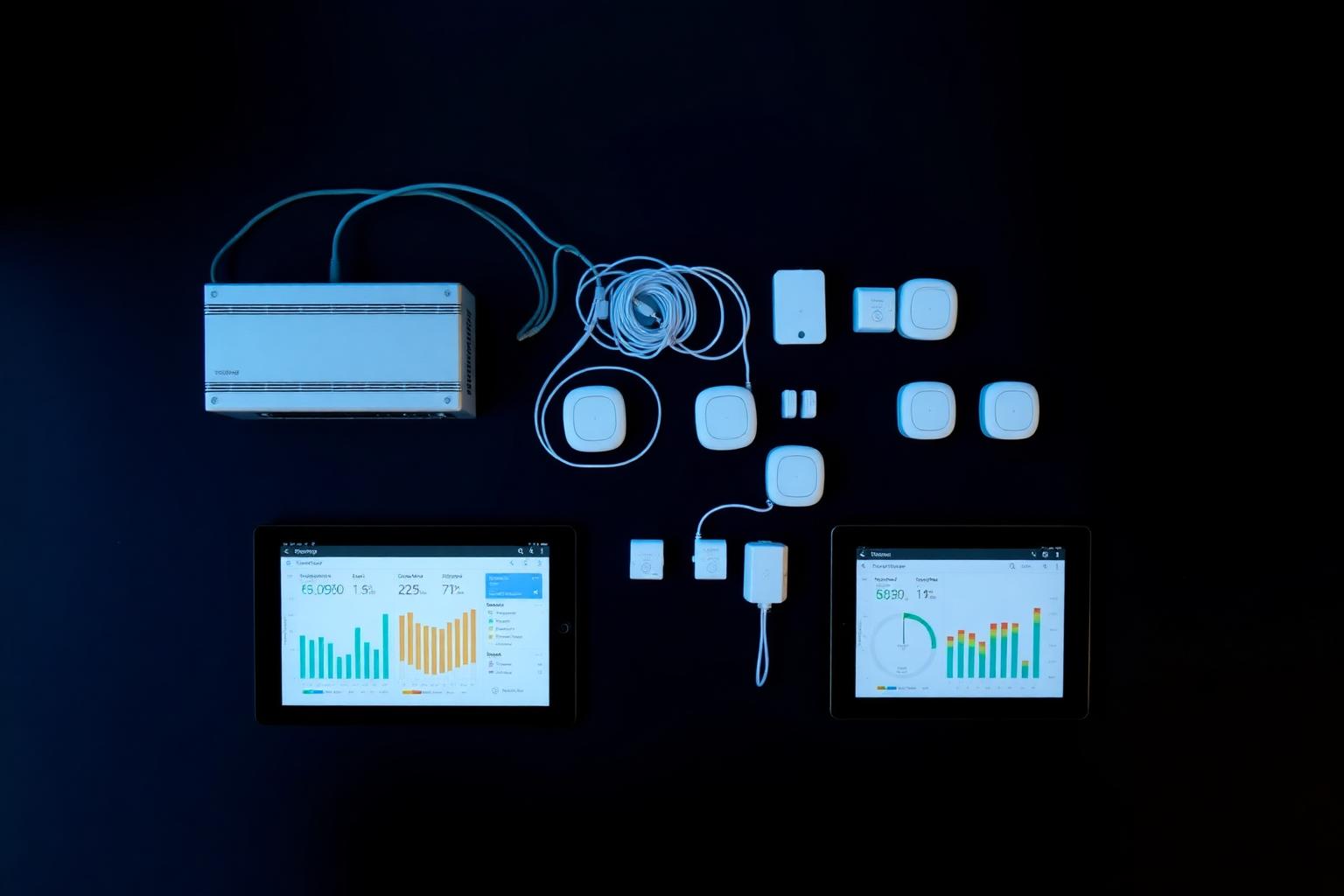
Smart building environmental monitoring system overview

Common protocols

Modbus, BACnet, MQTT

Sensor density

1 per 100 m² typical

Data interval

1–5 min

Frameworks

BREEAM, WELL, NABERS

01

What makes a building 'smart' for air quality

A smart building is not defined by the brand of its BMS or the existence of an app. It is defined by closed feedback loops between sensing, control and outcome. For air quality, the minimum set is: continuous measurement of the parameters that matter in each zone; an integration layer that delivers that data to the systems and people who need it; control logic that responds to changing conditions; and a verification layer that confirms the response actually happened.

Almost every commercial building in the UK has some of these elements. Few have all of them working together. The gap between "has sensors" and "smart" is the gap this guide is about.

02

Connected environmental sensors

The sensor layer in a modern smart building typically includes CO₂, PM2.5, PM10, TVOC, temperature, relative humidity and occupancy, with formaldehyde, NO₂, CO and differential pressure added in specific zones. Density is usually one node per 100–200 m² in open-plan space, one per meeting room, one per occupied service area, and additional outdoor reference units for ratio analysis. See temperature and environmental sensors for the underlying instrument types.

Whether sensors are hard-wired into the BMS field bus or run on a parallel wireless network is a project-specific decision. Hard-wired sensors are more reliable for control duty; wireless sensors are easier to densify after a fit-out. Many buildings run both.

03

BMS integration and protocols

Sensors that cannot share data with the systems controlling the air are decorative. The protocol options in UK commercial buildings are:

BACnet/IP and BACnet MS/TP — the default building controls protocol. Native support in most major BMS platforms.

Modbus RTU and Modbus TCP — older but ubiquitous; many sensor vendors expose Modbus registers as the lowest-common-denominator integration.

MQTT and REST — the cloud-native protocols. Standard for IoT platforms; require a gateway or middleware to reach the BMS.

The integration question is not "which protocol is best" but "which combination of protocols delivers the data to every system that needs it." See building management systems for the integration architecture in detail.

04

Ventilation and occupancy control

The headline control loop is demand-controlled ventilation: CO₂ and occupancy signals trigger variable-air-volume dampers, AHU fan speed and outdoor-air dampers to match supply to demand. Done well, DCV cuts ventilation energy by 20–40 % while improving zone-by-zone IAQ. Done poorly, it under-ventilates transient peaks and over-ventilates empty rooms.

The non-headline loops matter just as much. PM2.5 thresholds can switch filtration banks; TVOC trends can flag commissioning issues with new fit-outs; humidity readings drive dehumidification stages. A genuinely smart building uses every channel of its data, not just CO₂.

05

Dashboards, analytics and operational decisions

Live data without visualisation is wasted. A working facilities team needs three views: a real-time floor-plan heatmap for situational awareness, a 24-hour trend strip for shift-handover, and a 30-day analytical view for trend identification. See air quality dashboards for the visualisation layer and air quality analytics for the analytical layer.

Above the dashboard sits the decision layer: setpoint changes, maintenance triggers, occupant communication and capital-investment cases. The maturity of a smart-building IAQ programme is measured by how often dashboard data actually changes a decision.

06

Healthy building frameworks

BREEAM Hea 02, WELL Air features A01–A12, RESET Air, the WELL Performance Rating and Fitwel all require continuous IAQ monitoring as a precondition for credit. They differ in which parameters they prioritise, what reporting frequency they expect and how stringent the underlying performance thresholds are.

We help clients specify monitoring fleets that satisfy the framework they are pursuing, but we do not claim guaranteed certification outcomes — the awarding bodies assess each project on its own evidence.

07

Limitations and the importance of calibration

Automation amplifies errors. A miscalibrated CO₂ sensor that reads 200 ppm low will systematically under-ventilate every zone it controls. A drifted PM sensor will silently miss spikes. The cure is unglamorous: planned recalibration, periodic co-location checks, documented setpoint review and explicit commissioning. The "smart" in smart building only delivers when the metrology underneath it is being maintained.

See how air quality sensors are calibrated for the underlying maintenance regime, and smart building monitoring for the deployment service.

08

Frequently asked questions

  • Does a smart building automatically have good air quality?

    No. A smart building has the sensors and actuators to deliver good air quality, but only if the control logic, setpoints and maintenance regime are correct. Many BMS installations include CO₂ sensors that are never used in control, or VOC sensors set up to alarm only at thresholds occupants never reach.

  • Can a smart building meet BREEAM or WELL on monitoring alone?

    Monitoring is necessary but not sufficient. BREEAM Hea 02 and WELL Air features award credits for continuous monitoring with display, but full credit requires demonstrated performance against the underlying targets — adequate ventilation, low TVOC, low formaldehyde. We do not claim any guaranteed certification outcome.

  • Should air quality sensors be on the BMS or on a separate IoT platform?

    Both, usually. BMS integration is what closes the control loop on ventilation. A separate IoT or analytics layer is what gives the facilities team long-term trend visibility, anomaly detection and reporting. The two should share data through Modbus, BACnet, MQTT or REST.

  • What is the value of an air quality dashboard for facilities teams?

    A dashboard turns a stream of point measurements into operational decisions: which zones are under-ventilated, when peak occupancy actually happens, whether maintenance interventions worked. Without one, sensor data is wasted.

Next step

Discuss an Air Quality Monitoring Project

Speak to a consultant