Monitoring fundamentals

What is an Air Quality Monitor?

An air quality monitor is the instrument that turns the invisible chemistry of indoor air into numbers an engineer can act on. This guide explains what those numbers mean, where the indicative-vs-professional line sits, and how to choose the right monitor for your building.

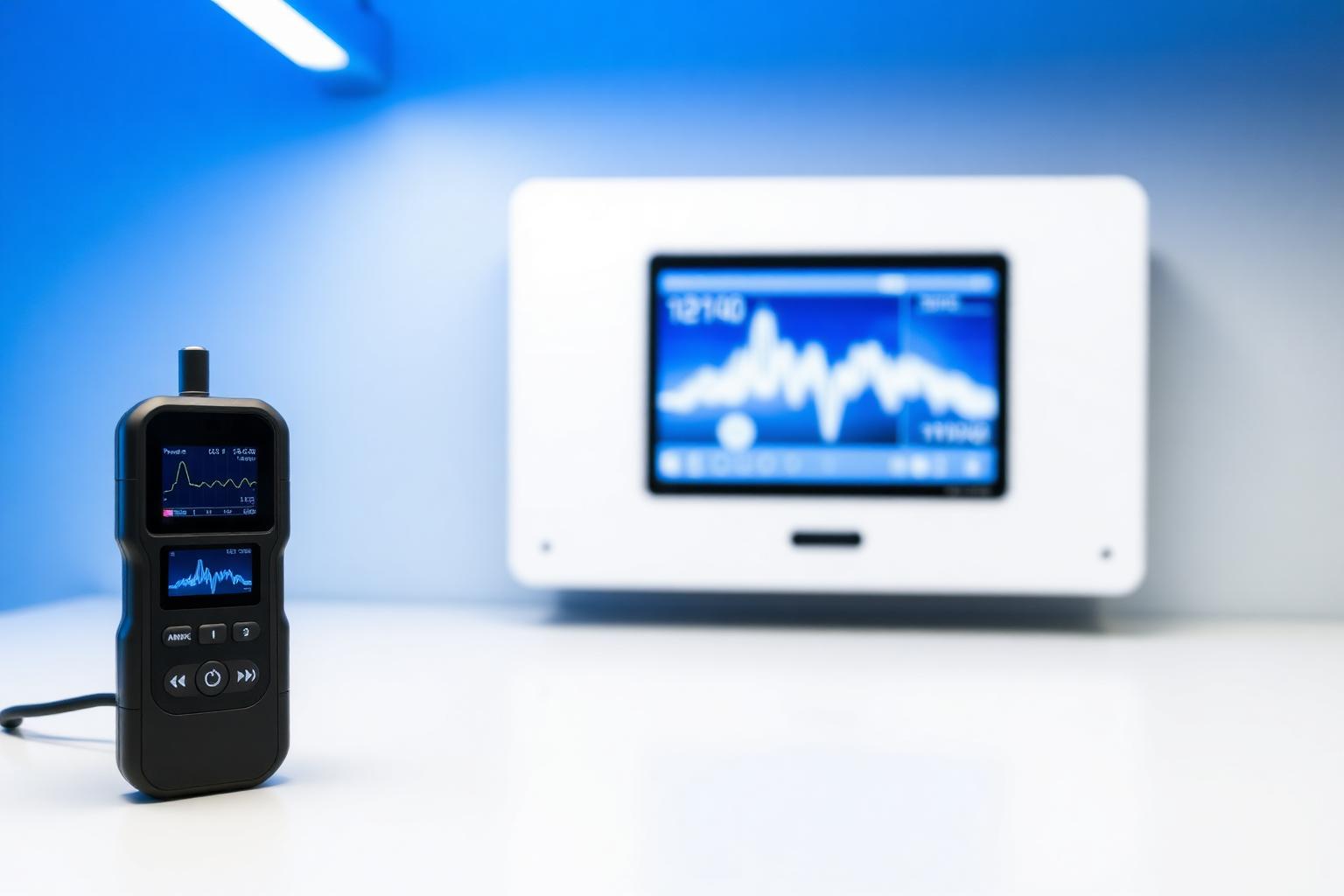
Wall-mounted professional air quality monitor in a modern office

Common parameters

CO₂, PM, VOC, T, RH

Sensor lifetime

5–10 years

Indicative accuracy

±10–30 %

Reference accuracy

±2–5 %

01

What an air quality monitor actually measures

An air quality monitor combines one or more gas, particulate or environmental sensors with signal conditioning, data storage and — in modern instruments — a network interface. The headline parameters in a commercial UK monitor are carbon dioxide, particulate matter (PM2.5 and PM10), total volatile organic compounds, temperature and relative humidity. More specialist monitors add carbon monoxide, nitrogen dioxide, ozone, formaldehyde, radon or specific solvents.

What a monitor does not measure is air quality in the abstract. It measures the concentration of specific pollutants at the position of its inlet. Interpreting those numbers — against WHO guidelines, HSE workplace exposure limits, CIBSE TM40 targets or BREEAM thresholds — is a separate exercise that depends on the building, the occupants and the time of day. See our indoor air quality monitoring overview for the wider context.

02

Portable, fixed and networked instruments

Portable monitors are battery-powered handhelds used for spot checks, complaint investigations and walk-through surveys. They prioritise fast warm-up, an integral pump or diffusion inlet, and a logging memory measured in days.

Fixed monitors are mains-powered, wall- or ceiling-mounted instruments designed for permanent installation. Sampling is typically diffusive, data is logged locally and exported by USB or Modbus to a BMS.

Networked monitors add a wireless or wired data link to a cloud platform. They form the basis of IoT air quality monitoring deployments, where dozens to hundreds of nodes are managed centrally.

Most commercial projects use a mix: a fleet of fixed networked monitors providing continuous trend data, supported by one or two reference-grade portables for verification and incident response.

03

Indicative versus professional-grade monitoring

The single most important distinction is between indicative and reference-grade instruments. The terms are defined formally in EU equivalence guidance and informally in product datasheets, and the difference is large enough to change the answer to a compliance question.

Indicative instruments deliver real-time trend data at low cost. Typical uncertainty is ±10–30 % for PM and ±50 ppm for CO₂. They are appropriate for ventilation diagnostics, occupant feedback, BMS triggers and BREEAM Hea 02 monitoring credit evidence.

Reference-grade instruments are traceable to national standards and certified to performance test specifications such as MCERTS or US EPA equivalent methods. Uncertainty is typically ±2–5 % and the data is suitable for regulatory reporting or expert witness use. They are an order of magnitude more expensive than indicative kit.

A professional deployment matches instrument class to the question being asked. There is no point paying for reference-grade analysis to answer an occupant comfort question, and no point asking an indicative sensor to confirm a workplace exposure limit excursion.

04

Sensor types inside the box

A monitor is only as good as its sensors. The dominant technologies in UK commercial monitors are:

Non-dispersive infrared (NDIR). The de facto standard for CO₂. Robust, low drift, 5–10 year typical lifetime. See our companion article on how CO₂ monitoring works.

Optical particle counting / laser scattering. The basis of nearly all indicative PM2.5 and PM10 sensors. Counts individual particles by the light they scatter, then estimates mass.

Photoionisation detection (PID). The dominant TVOC technology for portable and field instruments. Sensitive but non-specific.

Metal-oxide semiconductor (MOS). Low-cost TVOC and gas sensing for indicative monitors. Drifts and cross-sensitive to humidity.

Electrochemical cells. Used for CO, NO₂, O₃, H₂S and similar reactive gases. Two-to-five year working life.

See air quality sensors for technology-by-technology detail.

05

Data logging and connectivity

Modern monitors are data-first instruments. The useful capability questions are:

Logging interval. One minute is standard; ten seconds is needed for incident reconstruction; one hour is enough for long-term trending.

Local storage depth. Months of buffered data protects against network outages.

Protocols. Modbus RTU or TCP for BMS integration; BACnet for building controls; MQTT or REST for cloud platforms.

Wireless options. Wi-Fi for retrofits; LoRaWAN for long-range, low-power outdoor deployments; cellular for fully off-network sites.

Visualisation. Vendor dashboards vary widely in quality. A monitor that exports cleanly to your own air quality dashboard is more valuable than one with a glossy but closed app.

06

How to choose the best air quality monitor for your building

"Best" depends entirely on the use case. The selection conversation we have with clients works through five questions:

What decisions will this data drive? Occupant comfort, ventilation control, compliance evidence and incident investigation each demand different sensor classes.

What pollutants matter in this space? A school classroom and a print room have almost no parameters in common.

What accuracy is genuinely required? Specifying reference-grade when indicative is sufficient burns budget; the reverse causes flawed decisions.

How will the data be integrated? A monitor that cannot speak to the BMS is a monitor whose alerts get ignored.

Who owns calibration? Every continuous monitor drifts. Plan recalibration and field checks before purchase — see our guide to sensor calibration.

We do not rank or recommend consumer brands. For commercial selection support, talk to us about your specific building and parameters.

07

Limitations and when professional deployment is appropriate

Even good monitors lie when they are misused. The recurring failure modes are: placement near a supply diffuser (dilutes everything), placement near a known source (over-reports the zone), single-point monitoring of a zone with strong spatial gradients, and treating indicative TVOC as a substitute for speciated VOC analysis.

Professional deployment is appropriate when the data will inform a regulated decision, a complaint investigation, a BREEAM or WELL submission, an incident response or any capital project costing more than the monitor itself. For everything else — occupant engagement, ventilation tuning, day-to-day operations — a well-chosen networked indicative monitor is usually right.

08

Frequently asked questions

  • What is the difference between an air quality monitor and an air quality sensor?

    A sensor is the underlying transducer (an NDIR cell, an optical particle counter, an electrochemical cell). A monitor is the finished instrument that houses one or more sensors with signal conditioning, a display or data interface, and — usually — calibration and traceability documentation.

  • Are consumer indoor air quality monitors accurate enough for compliance?

    Not for regulated or evidential measurement. Consumer-grade devices are useful for occupant awareness and trend spotting, but compliance with HSE WELs, BREEAM Hea 02 or WELL Air requires instruments with documented accuracy, calibration traceability and an appropriate sampling protocol.

  • Where should an air quality monitor be installed?

    In the breathing zone (1.1–1.7 m above floor level), away from windows, doors, HVAC supply diffusers and direct sources. Place enough monitors to characterise the zones occupants actually use, not the easiest mounting points.

  • How often do air quality monitors need recalibration?

    Manufacturer guidance varies, but a working rule of thumb is annual factory recalibration for reference-grade instruments and quarterly field checks for continuous indicative monitors. Sensors exposed to high concentrations or aggressive chemistry drift faster.

Next step

Discuss an Air Quality Monitoring Project

Speak to a consultant