Monitoring equipment
Air quality monitors for commercial UK buildings
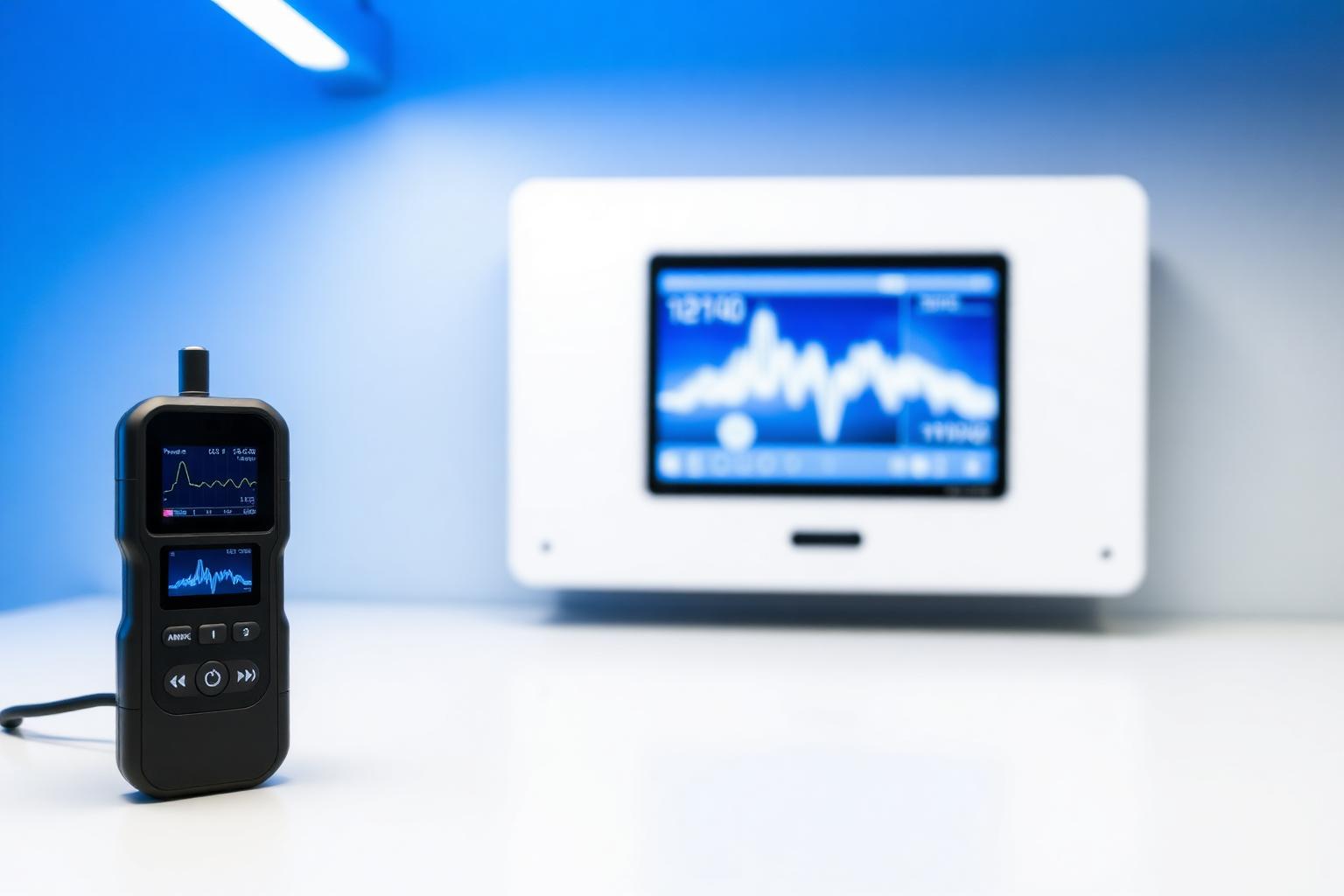
From handheld walk-through instruments to fixed, networked monitors that report continuously to a dashboard — choosing the right air quality monitor depends on what you need to evidence, how often you need data, and where the instrument will live.
Categories
Four classes of air quality monitor
No single instrument suits every application. The four categories below differ in accuracy, power, connectivity and the questions they can credibly answer.
01
Portable / handheld
Battery-powered walk-through instruments for spot checks, complaint investigations and short-term surveys.
02
Fixed indicative
Wall-mounted continuous monitors that stream CO₂, PM, TVOC, temperature and humidity to a dashboard.
03
Networked sensor systems
Multi-zone deployments with a gateway, secure connectivity and per-room trend analysis.
04
Reference-grade instruments
Higher-accuracy analysers and gravimetric samplers used for compliance, occupational hygiene and research.
Selection
How to choose a commercial air quality monitor
Start with the question. A facilities team confirming whether a classroom is well ventilated needs continuous CO₂ data, not a one-hour handheld snapshot. An occupational hygienist investigating a solvent exposure needs a calibrated PID or sorbent-tube sampling, not an indicative TVOC reading.
Match pollutant coverage to the building. Offices and schools generally need CO₂, PM2.5, temperature and humidity as the baseline. Healthcare, laboratories and industrial sites typically add NO₂, formaldehyde, PM10 and specific solvent monitoring depending on the source profile.
Specify accuracy, sampling interval and data retention. Continuous monitors should report at one to five minute intervals with at least twelve months of historical data accessible to operators. Calibration intervals and traceability should be documented before purchase, not after.
Comparison
Indicative vs higher-grade instruments
| Capability | Indicative monitor | Reference / higher-grade |
|---|---|---|
| Typical purpose | Trends, alerts, occupant awareness | Compliance evidence, exposure assessment |
| Accuracy (CO₂) | ±50–75 ppm with NDIR auto-cal | ±30 ppm or better, certified calibration |
| PM2.5 method | Optical light-scatter | Gravimetric or beta-attenuation |
| Calibration | Annual factory or in-field | Pre/post-deployment with traceable reference |
| Data interval | 1–5 minutes | 1 second to defined sampling protocol |
| Suitable for BREEAM/WELL? | Indicative trending only | Yes, with documented method |
Limitations
What air quality monitors cannot tell you
Honest monitoring matters more than impressive dashboards. A clear understanding of where instruments stop helping is part of every credible deployment.
Indicative TVOC ≠ specific compounds
Broad TVOC readings cannot identify a specific solvent. Targeted sampling and laboratory analysis is needed for source identification.
Sensor drift is real
Low-cost optical and electrochemical sensors drift over months. Without calibration, trends remain useful; absolute values do not.
Placement defines the data
A monitor in the wrong place — near a diffuser, in direct sun, behind a partition — will tell the wrong story regardless of sensor quality.
FAQ
Common questions about air quality monitors
Discuss an Air Quality Monitoring Project
Independent specification, sourcing and deployment of monitoring equipment for UK commercial buildings.
Speak to a consultantFurther reading
By pollutant